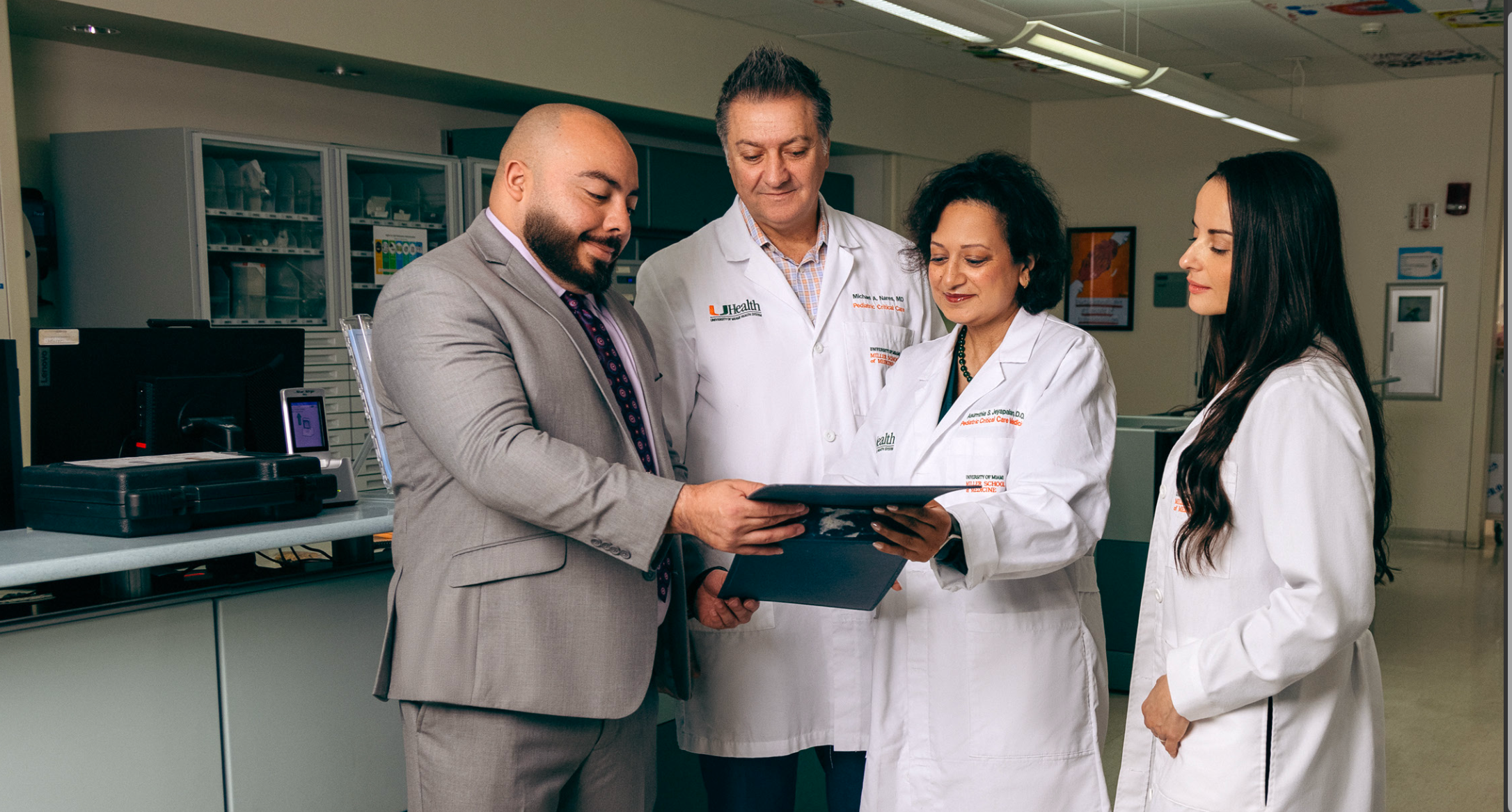
The Nurses Magazine® is proud to name Jose Pastran Arauz, MBA, BSN, RN — Nurse Manager of the Pediatric Intensive Care Unit at Holtz Children's Hospital — The Most Influential Hispanic Nurse Leader to Follow in 2026. In the Pediatric ICU at Jackson Memorial, a leadership philosophy forged in the Marine Corps is quietly reshaping what it means to run a modern nursing team — and what it looks like when a leader insists on eating last.
Jose Pastran Arauz, MBA, BSN, RN, is the Nurse Manager of the Pediatric Intensive Care Unit at Holtz Children's Hospital & The Women's Hospital at Jackson Memorial Medical Center. A former Marine infantryman turned trauma nurse turned nurse executive, his story arcs from a childhood injury in a low-income immigrant household to a leadership seat at one of the country's most demanding pediatric trauma institutions. In this Fall 2025 cover conversation, he speaks with The Nurses Magazine® on servant leadership, the mentorship of rising nurses, and the quiet discipline of doing the right thing when no one is watching.
Leadership Philosophy
How would you describe your leadership philosophy, and how has it shaped the teams you oversee?
The Marine Corps instilled in me what we called “leaders eat last.” It shaped my belief in servant leadership, which emphasizes that a servant leader prioritizes the needs of others over their own. To me, this means my front-line team comes first, mainly because they provide the first point of care to our patients. They know which gear and supplies are needed and which trends are emerging before you do.
A servant leadership approach creates a circle of trust where they know they can bring things to the table to find a common solution. Once your team knows that you, as a leader, are trustworthy, they become loyal and cooperative, making it easier to establish lines of communication. My philosophy on leadership is about serving others.
What challenges do today's nurse leaders face, and how do you believe we can overcome them? Where do you see the nursing profession heading in the next five years?
Although we have a more stable workforce today than the initial post-COVID era, we are still facing challenges of increased nurses retiring and nurses not staying at the bedside to pursue a higher education. I face these challenges by accepting reality and that these issues arise from the nature of our profession. Hence, I avoid perceiving these obstacles as negative.
My solution for overcoming these challenges is to provide sufficient support to the nurses. For example, I support and mentor nurses who wish to shadow a CRNA, those who need a letter of recommendation for their nurse practitioner program, or the young nurse who aspires to be a nurse leader. This, in turn, creates a unit where many nurses want to work with us, as they feel supported in whatever decision they make. I am grateful that Jackson provides substantial support to reduce burnout, increase morale, and offer endless activities to help our nurses feel supported.
The next five years, we will see more technology integrated into nursing work. I foresee a significant use of artificial intelligence, and I can only hope that it becomes a source of problem-solving and solutions, and a more effective workforce. I believe this will go hand in hand with the personalized preventive medicine shift driven by digital health technologies such as wearables, remote monitoring, and telehealth platforms. This dominoes effect will also continue to increase lifespans to our already aging population, shifting the focus to chronic and geriatric care. In the next five years, we will increase our focus on health equity and reduced health disparities. I see the work Jackson has done preemptively over the years, and I can see us leading the nation in many of these areas.
How do you foster a culture of a healthy working environment that reflects compassion, respect, civility, accountability, and excellence within your organization?
Fostering a healthy working environment culture is essential for our units. I have contributed to this culture by molding a workplace environment where respect is upheld in all interactions. All nurses practice open communication, civility, and value diversity in people and opinion. In our unit, we do not perceive errors as something entirely negative. To us, mistakes provide us with an avenue to learn and grow. Thus, our approach to mistakes helps us foster accountability.
Regarding excellence, all nurses are well-mentored and supported to advance their learning, innovation, and leadership skills. The culture at Jackson is conducive for staff and families and reflects our motto: ‘Miracles Made Daily.’
Professional Impact & Accomplishments
What career achievement are you most proud of, and why does it stand out for you?
I am most proud of attaining my Health Executive MBA and everything I learned through the process. The professors' expertise has given me an advantage, enabling me to better understand our healthcare landscape. As a nurse leader, this knowledge helps me break down changes and explanations for our clinical staff, and helps them see not just the clinical aspects, but the bigger picture from a business and policy standpoint.
It has allowed me to prepare for challenges, identify operational bottlenecks, and partner with other specialties to make appropriate interventions. It also made me realize that I will be a lifetime learner — I enjoy the experience so much, it left me yearning for more.
Can you share a project, initiative, or decision that significantly improved patient care or staff outcomes?
In our quality task force, we worked on becoming a reliable organization by improving our safety and quality metrics. I started by listening to the customer's voice, something I learned in Lean Six Sigma. In my case, the voice pointed to several problem areas. To solve the issues, I began by following our nurses during dressing changes and blood culture collections. I asked the frontline nurses to share their input on which areas needed improvement.
It was essential to discuss the findings with the unit-based council during our monthly meeting. The purpose of our meetings is to discuss staff issues, quality improvement, and make adjustments where necessary. From the meeting, the council decided on various solutions. One was generating a thorough shopping list that included all the necessary equipment for the dressing changes and blood cultures.
In the findings, we noticed that pediatric nurses needed assistance holding babies to maintain the sterile field. In this case, we resolved the issue by introducing the buddy system. The buddy system also allows nurses to provide positive feedback to each other on how to perform certain procedures properly, thereby helping prevent errors. We are now in the phase of working with Jackson's information technology team to have a sign-off on our buddy's name to be documented under dressing changes and finalizing CHG bath education for our families and patients. We are currently over 600 days CLABSI-free. All the solutions raised are the result of effective team effort and commitment to delivering quality, safe care.
In what ways have you helped strengthen the nursing workforce, particularly regarding retention, mentorship, or new-graduate support?
I value and prioritize interacting with my staff. I remain committed to attending all morning huddles and staff meetings. I have made it my habit to arrive early in the morning to capture the night shift staff and solve any questions or issues they might have. With my open-door policy, nurses approach me with any questions, whether work-related or career-related.
I have networked to help them shadow other CRNAs and nurse practitioners, and I have also taken the initiative to inquire about schools and other career options they can pursue. I strive to tailor support that matches the nurses' interests. Some want to float and learn about other specialties, such as critical transport and emergency room. For my new graduate support, I enjoy taking them to lunch or a walk around the campus and showing them what resources are available. My approach is to ensure they feel supported during their adjustment periods.
I make a point to celebrate my staff for all their wins — big or small — whether that involves earning a certificate or being named as the miracle maker of the month. Acknowledging individual input helps boost morale and motivation.
Advocacy, Diversity & Innovation
How do you advocate for equitable and culturally competent care within your institution?
All work we do must include a human touch. I remind our staff that the work we do and the lives we touch are special. I found it effective to organize frequent meetings with the multidisciplinary teams. During such meetings, we discuss methods to improve our service delivery practices to uphold culturally competent care that meets the needs of those we serve.
Our stance on health equity is that no matter who the patient is or where they came from, we will join them on the tough road ahead and fully support them. We work together to deliver the best care we can. I am proud to work with my team and observe how dedicated they are to going above and beyond for every patient they serve.
What innovations or emerging trends in healthcare are you most excited to lead or support?
At the top of my list is technology. The continuing technological advances will have a significant impact on healthcare practices. There is a lot of potential for emerging technologies to aid the nursing workforce. However, any innovation is prone to having a downside. I can only support technologies that make nursing work effective and efficient. It is also imperative to integrate sustainable innovations that align with established nursing practices.
Specifically, I am excited about and support the trend to push nurses to advance their learning. I want to see more involvement in policy and advocacy for our profession that can impact our scope and, ultimately, the communities we serve. I am also excited about the expanding goals at Jackson, especially those aimed at breaking barriers to healthcare access and use.
How are you preparing your teams for a rapidly evolving healthcare environment?
There is no denying that the healthcare environment is growing fast and will continue to do so due to technological innovations. Presenting a vision is only half the work — getting people to believe in it and act on it requires intentional strategies. I believe in connecting the Vision to Purpose by putting the why to the what. It is essential that the team fully understands what they are doing and why they should do it.
I also believe in empowering the team to lead change. My approach is to involve the team in creating initiatives. The more involved they are, the more invested they are in achieving a positive outcome. Last, but not least, transparency is the best form of communication, so trust is created between us in an essential habit I have learned to express.
Personal Journey & Inspiration
What initially inspired your journey into nursing, and what continues to motivate you today?
I came to this country as an immigrant. My family ranked as a low-income household. As a result, my siblings and I had to work to boost our family's income. I started working at a bicycle rim factory after school at the age of eight. One day, while working with my mom and sisters, I cut my inner eye and needed to go to the hospital. With no reference, my mother took me to a Catholic church where doctors volunteered to treat people for free as an outpatient clinic. The doctors referred me to a hospital, and this was where I had my first hospital experience.
Years later, I joined the Marine Corps as an infantryman. I was selected to attend an advanced trauma course as part of my preparation before deploying to Afghanistan. Marines rely on Navy corpsmen, but we are supplied with only two medics for a group of 36 Marines. That means some Marines must be cross-trained, just in case our medics get injured. My goal was to become a trauma nurse after completing my service following that experience. Full circle, not only did I become a trauma nurse, but I am able to serve the same community that I grew up in — all thanks to Jackson.
Who has had the greatest influence on your leadership style, and in what way?
I love reading, especially books on leadership. I also enjoy meeting and interacting with leaders I admire to learn more from them. My MBA was instrumental in me meeting some great leaders. For example, I met David Zambrana, who shared many of his experiences with me. His experiences were insightful in helping me improve my leadership skills and practices.
There is also Joanne Ruggiero, who I admire and pick her brain whenever I see her. I cannot forget Hamilton Clark and Oscar Betancourt for impacting me with wisdom and guidance after accepting a meeting with me and giving me the opportunity to ask them for advice on my career when I had barely transitioned to an associate nurse manager. I have studied their interviews to understand what makes them such impactful leaders, and each of them has inspired me to elevate myself and embrace selfless leadership. Their influence has strengthened my confidence that our organization's impact is more than just a job — it is a profound purpose that has taken root within me.
What core values guide your decision-making as a nurse executive?
Compassion for my staff and for our patients is the core value that keeps me grounded. Constantly speaking with families and staff and understanding their struggles allows me to constantly renew my compassion and guide the work I do.
Doing the right thing when no one is looking is my definition of integrity. Integrity guides me as tough decisions need to be made and I have to look at the big picture and do what is right for the majority. I have to put personal biases aside and not let external voices affect my decision-making.
Courage allows me to have a relentless work ethic, not shy away from challenges, and follow through on commitments, no matter how challenging they might be.
Wisdom, Influence & Legacy
What advice would you offer to rising nurse leaders or aspiring nurse executives?
My advice is to find a strong why, as it will guide you through your toughest times. Find something worth fighting for, something meaningful that can be your beacon of light in your darkest days. We need to focus on our talent and mastering our craft — everything else will come. Let your work speak for itself — don't talk about it, be about it.
It is essential to establish a proper support system, including mentors who will guide and inspire you. Self-improvement is also necessary. Take the opportunity to continue learning, and don't shy away from challenges.
What legacy do you hope to leave within the Jackson Health System, the nursing profession, and the communities you serve?
I truly believe in what we do at Jackson. I can't tell you the number of times we have saved lives and gone above and beyond for our patients, from our Ryder Trauma Center to our Holtz Children's Hospital. No other institution I have ever worked at has the amount of expertise and compassion we demonstrate, or the ability to constantly improve ourselves with the utmost accountability.
I am honored to continue serving our employees and community and expanding our reach to those most in need. As for our nursing profession, I would love to leave a mark as an inspiration for nurses to pursue greatness, no matter the field they want to follow. It is my goal to continue to advocate for our profession and push boundaries in how we can have a word on the table.
“Leaders eat last. My front-line team comes first, because they provide the first point of care to our patients. Once your team knows you are trustworthy, they become loyal and cooperative — and that is where real leadership begins.”
Editorial Note
This Fall 2025 Cover Story is part of The Nurses Magazine®'s ongoing Leadership & Career series, profiling the nurse executives shaping the next generation of American healthcare. Jose Pastran Arauz, MBA, BSN, RN serves as Nurse Manager of the Pediatric Intensive Care Unit at Holtz Children's Hospital & The Women's Hospital at Jackson Memorial Medical Center.